Understanding the Bortle Scale: What You Can Actually See From Your Backyard
It’s clear tonight, not a cloud in the sky. You finally haul that brand new telescope you got for Christmas or birthday and look up. What the..?
Where’s the Milky Way? The nebulae? Messier Catalog objects!?
Oh they’re up there and your new gear works just fine. Put the receipt away. You’re standing under a Class 6 suburban sky.
That sounds cool but its actually really annoying.
All those porch bulbs, sodium-vapor streetlights, and the ambient glow of a strip mall three miles down the road are to blame for the lack of awe in the sky above.
For decades, amateur astronomers had no standard way to describe just how deep dark or washed out their local sky actually was. One observer’s “pretty dark backyard” was another observer’s light-polluted nightmare.
In 2001, an astronomer named John E. Bortle finally made it cannon in Sky & Telescope. Today, the Bortle Scale is the nine-level rating system we use to figure out what our eyes can realistically pull out of the dark.
So what does it mean?
The Bortle Scale and Your Sky
You’ve seen the photos. You’ve scrolled past a long-exposure shot of the Milky Way arching over a desert canyon like a spilled bucket of diamonds. That’s the whole reason you’re out there standing in the cold staring up.
We hate to break it to you, but that’s not what your suburban driveway sky looks like. It’s out there, but maybe not where you are right now, standing next to that newly collimated scope. If you’re lucky enough to live close to the darkest skies in the country, we envy you.
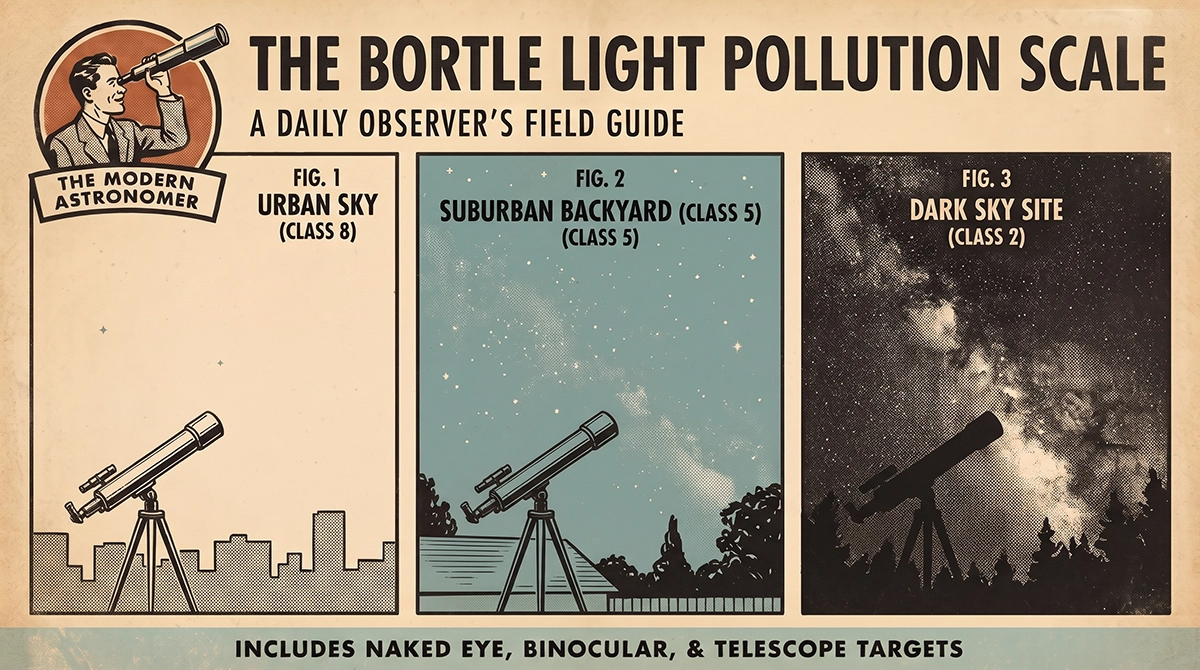
The Bortle Scale runs from Class 1 (the darkest, untouched skies on Earth) all the way down to Class 9 (Manhattan on New Years Eve). You don’t need a light meter to find your number (we have a map down below) but really its just twenty minutes in the dark and a quick look straight overhead:
- Class 1–2 (Truly Dark Sky Sites): Think remote deserts, high mountain passes, and deep inside national parks miles from the nearest highway. Out here, the Milky Way is bright enough to cast faint shadows on the ground, and the Andromeda Galaxy (M31) is an easy naked-eye target. The darkest skies.
- Class 3–4 (Rural & Rural-Suburban Transition): Farmland and small towns where faint domes of light hug the horizon, while the sky straight overhead stays crisp and dark. The Milky Way still shows rich dust lanes, and 10×50 binoculars turn star clusters into glittering fields of pinpoints.
- Class 5–6 (Suburban Skies): Home base for most of us. City lights wash out the fainter stars, and the Milky Way either fades to a ghost overhead or vanishes near the horizon. Still, bright constellations, the Moon, major planets, and showpieces like the Pleiades cut right through.
- Class 7–9 (Urban & Inner-City Skies): Heavy city lights turns the night a milky gray or orange from horizon to horizon. The Moon and only the brightest stars seep through the glow.
Why Your Number Matters
Knowing your Bortle rating shouldn’t kill the mood. Just temper it.
If you are in a Bortle 8 zone and spend an hour hunting for that faint, face-on galaxy you saw a picture of online, you’re going to have a bad night. Aim that exact same telescope at the Moon’s shadow line, Saturn’s rings, or a tight double star, and the view is razor-sharp regardless of the streetlights down the block.
Your Bortle also dictates what goes in your gear bag. Under dark skies (Bortle 1–3), a simple pair of 10×50 binoculars will keep you busy exploring the heavens all winter. Under suburban or city skies (Bortle 5–8), you’ll lean on higher magnification for planets, dual-band light-pollution filters for nebulae, or smart telescopes that stack exposures to cut straight through the glow.
Dial In Your Backyard Tonight
Next time you step outside, resist the urge to take a baseball bat to your neighbor’s aggressively bright white garage floodlight.
For now.
Check your Bortle Scale on the map below. Then set your local sky class on the Bortle Scale gauge at the top of our page and run Tonight’s Targets Selector on the front page for three targets you can actually see tonight without driving four hours into the desert or petitioning the city council to shut off the power grid.
You don’t need a mountaintop observatory to learn the night sky. Just a dark corner of the yard where the neighbor’s motion-sensor light can’t find you.