

Tonight’s Sky Guide: November 18, 2026
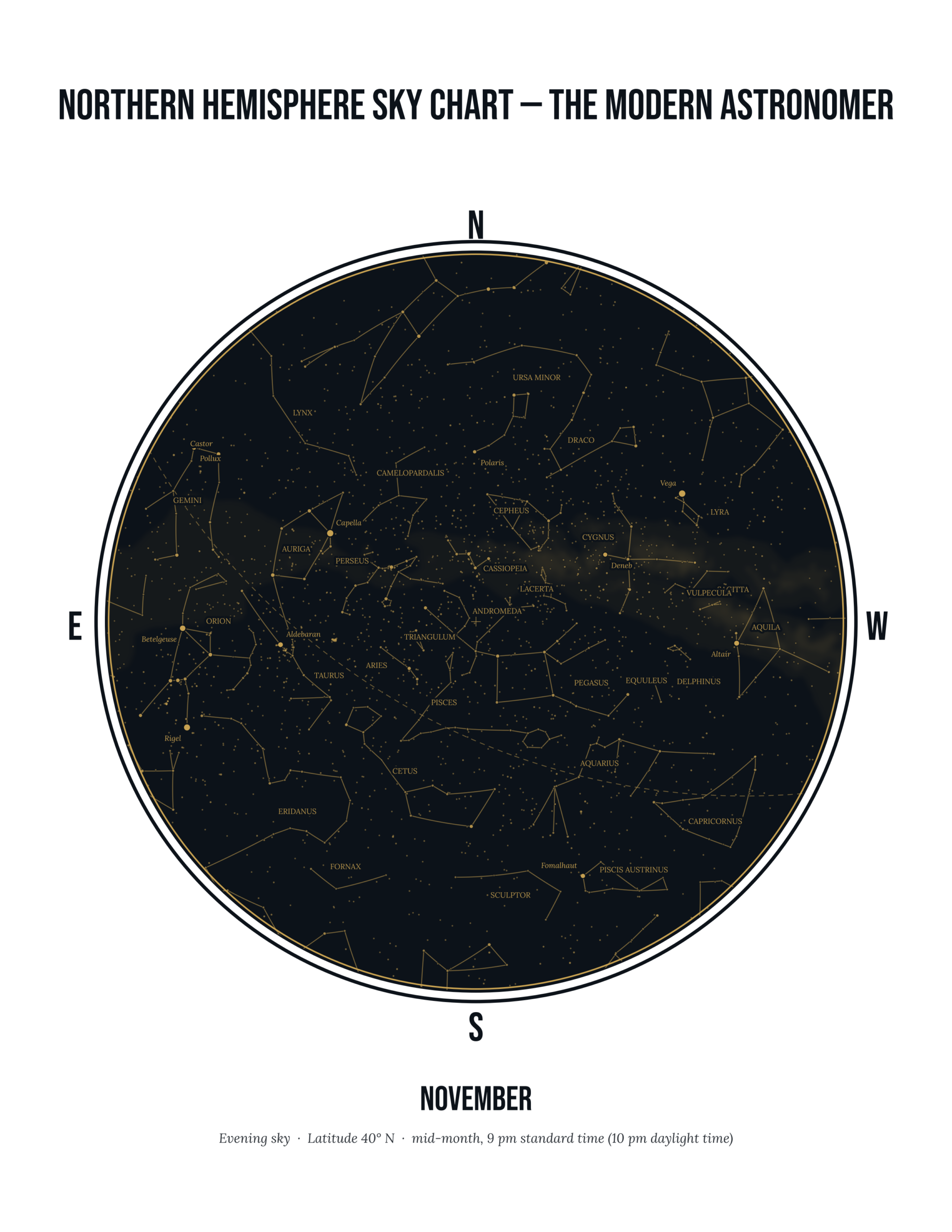
Grab your warmest winter jacket tonight, November 18, 2026, as a brisk autumn night sets the stage for prime stargazing across the United States. With the Moon sitting in a slender waxing crescent phase, dark skies offer a pristine canvas to spot brilliant Venus shining brightly in the western evening twilight and the giant planet Jupiter dominating the midnight skies.
Naked-Eye Observers
- Trace the glowing band of the Milky Way stretching high overhead from Cygnus in the west down toward Perseus in the east.
- Find the glittering Pleiades star cluster (Messier 45) rising in the east, marking the arrival of the classic winter constellations.
- Locate the Great Square of Pegasus high in the southern sky to help orient yourself among the autumn constellations.
Binocular & Small-Scope Observers
- Sweep your binoculars across the Andromeda Galaxy (M31) high in the south to catch the ancient light of our nearest galactic neighbor.
- Explore the sparkling stars of the Double Cluster in Perseus, a gorgeous pairing of open clusters rich in youthful blue stars.
- Turn your binoculars toward Jupiter to easily spot its four bright Galilean moons (Io, Europa, Ganymede, and Callisto) aligned near the disk.
Large-Scope Observers & Astrophotographers
- Target the Orion Nebula (M42), climbing higher into the southeastern sky after midnight, to reveal intricate glowing gas clouds and the Trapezium cluster.
- Split the stunning double star Albireo in Cygnus to capture its striking color contrast of sapphire blue and topaz yellow.
- Set up a wide-field tracked camera pointed toward Taurus and Perseus to capture a rich starscape framing the California Nebula.
Learn More
- Sky & Telescope – Weekly observing guides and interactive sky charts.
- EarthSky – Daily updates on visible planets, moon phases, and celestial alignments.
- Stellarium Web – Interactive online planetarium to track objects in tonight’s sky.