
Tonight’s Sky Guide: November 16, 2026 (United States)
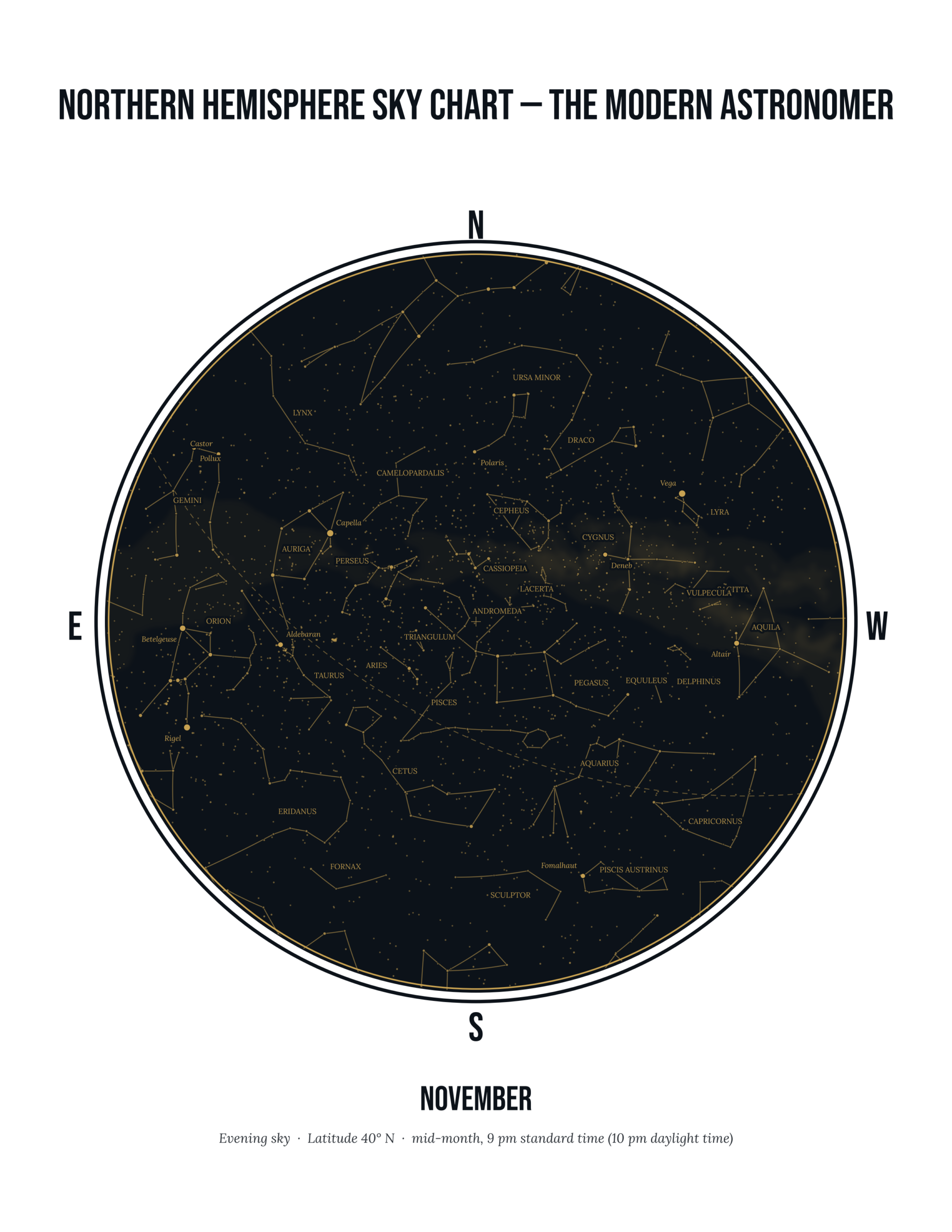
Step outside tonight, November 16, 2026, to catch the dazzling Leonid meteor shower peak alongside a brilliant waxing crescent Moon. The evening sky also treats stargazers to the gas giants Jupiter and Saturn glowing brightly in the south.
Naked-Eye Observers
- Scan the constellation Leo rising in the east-northeast late tonight to catch shooting stars from the Leonid meteor shower, expecting up to 15-20 meteors per hour under dark skies.
- Trace the Great Square of Pegasus high overhead in the southern sky as your main seasonal guidepost.
- Locate the bright, creamy light of Saturn in Aquarius during early evening, followed by the much brighter beacon of Jupiter dominating Taurus as midnight approaches.
Binocular & Small-Scope Observers
- Direct 7×50 or 10×50 binoculars toward the eastern sky to resolve the glittering stars of the Pleiades cluster (M45) nestled on the shoulder of Taurus.
- Use a small refractor to spot the delicate rings of Saturn and track its largest moon, Titan, glowing nearby.
- Sweep through the constellation Cassiopeia to discover rich open star clusters like NGC 457, affectionately known as the Owl Cluster.
Large-Scope Observers & Astrophotographers
- Target the Andromeda Galaxy (M31) with a wide-field astrograph to capture its sweeping dust lanes and satellite galaxies M32 and M110.
- Point your telescope at Jupiter to observe the Great Red Spot transit and capture crisp details in the planet’s equatorial cloud belts.
- Use a tracked DSLR or dedicated astro-camera with a fast lens pointed toward Leo to stack long exposures of Leonid meteor trails against the Milky Way backdrop.
Learn More
- Sky & Telescope – Weekly observing guides and celestial event updates.
- EarthSky – Night sky maps, planet trackers, and meteor shower tips.