

Tonight’s Sky Guide: November 24, 2026
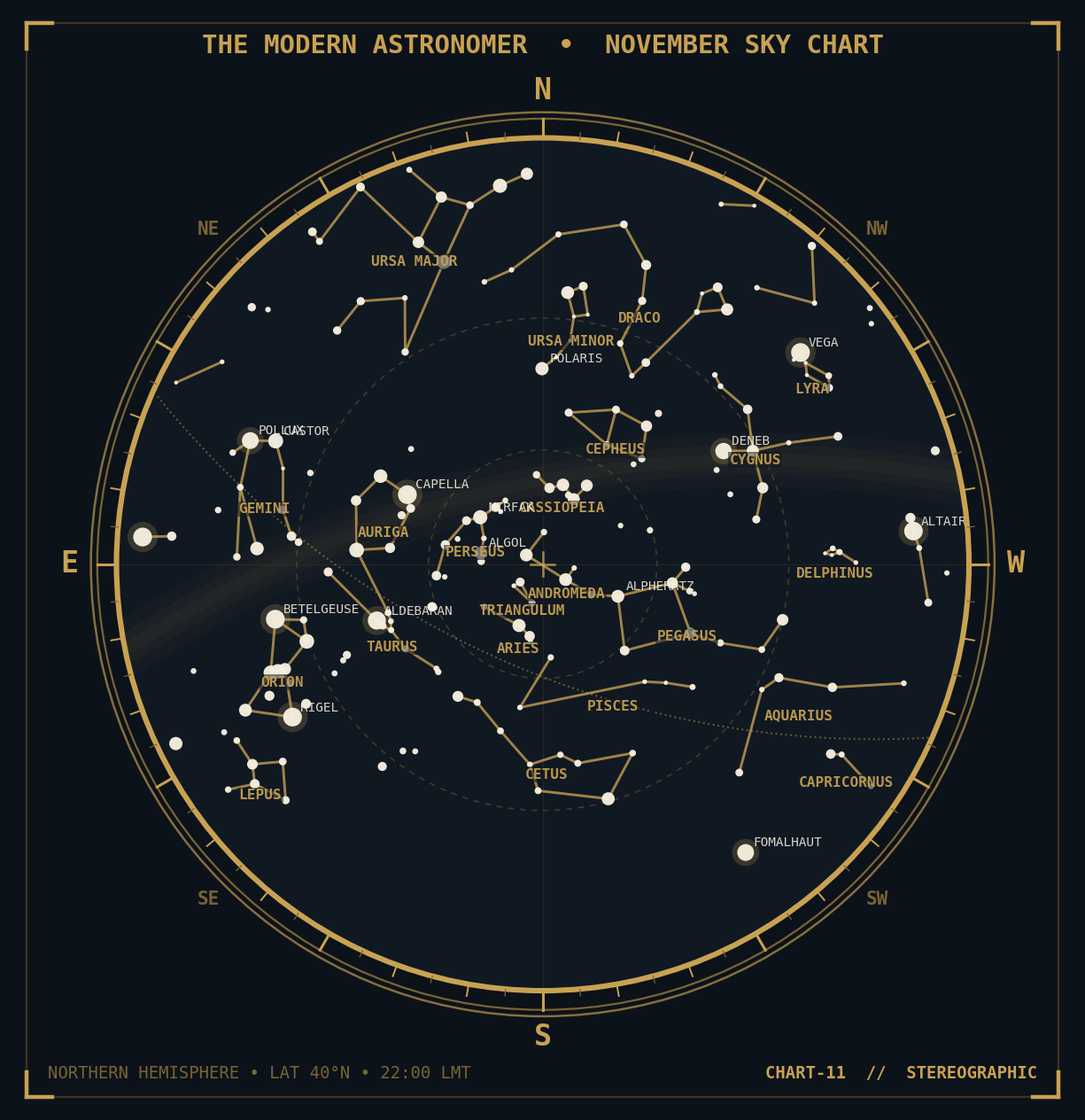
Tonight’s sky features the November Full Moon shining in Taurus alongside Uranus reaching opposition just one day later, creating a bright celestial backdrop for Northern Hemisphere observers. Saturn dominates the southern evening sky after sunset, while Jupiter and Mars rise in the late evening and a brilliant Venus emerges in the east-southeast before dawn.
Naked-Eye Observers
- Full Beaver Moon: Rising in the east near sunset, the fully illuminated lunar disk highlights dark basaltic plains (maria) and bright ejecta ray systems without optical aid.
- Saturn: Locate this steady, golden-hued planet high in the southern sky during early evening, noticeably lacking the atmospheric scintillation of surrounding stars.
- Autumn and Winter Constellations: Trace the Great Square of Pegasus and W-shaped Cassiopeia high overhead, while Taurus and Orion ascend in the east.
- Pre-Dawn Planets: Late-night or early-morning observers can spot bright Jupiter and ruddy Mars high in the southeast, with dazzling Venus low above the pre-dawn horizon.
Binocular & Small-Scope Observers
- Lunar Ray Systems: Although full-phase illumination minimizes crater shadows, binoculars reveal radiating ejecta streaks around Tycho and Copernicus alongside subtle limb details.
- Uranus at Opposition: Scan Taurus near the Pleiades (M45) to pinpoint Uranus at peak apparent magnitude (+5.6), keeping the nearby Full Moon just outside your field of view to spot its tiny blue-green disk.
- Bright Open Clusters: Counteract lunar glare by targeting high-surface-brightness star clusters, including the Pleiades (M45) in Taurus and the Double Cluster (NGC 869 and NGC 884) in Perseus.
- Saturnian System: A small refractor or reflector easily resolves Saturn’s tilted ring plane and its largest moon, Titan, orbiting nearby.
Large-Scope Observers & Astrophotographers
- Double Stars: Split colorful binary systems unaffected by moonlight, such as Almach (Gamma Andromedae) with its gold-and-blue contrast, or Eta Cassiopeiae.
- Planetary Imaging: Use high-frame-rate video capture (“lucky imaging”) late tonight to record crisp atmospheric details on Jupiter’s cloud belts and Saturn’s rings.
- Narrowband Astrophotography: Bypass broadband lunar skyglow by imaging emission nebulae in Perseus and Auriga through H-alpha and O-III filters.