
Stargazing 101: What You’re Actually Looking At Up There
There is a strange kind of stage fright that hits people the first time they decide to “get into astronomy.”
You step outside, crane your neck and suddenly your brain gets overwhelmed. It’s like when a writer opens a blank page. “What do I do now?” You knew you should have added to cart all those star charts and beginners books when you were shopping earlier. Or if you’re like me, you already bought the telescope.
Relax.
Before we get too deep into focal ratios, light-pollution scales, or measuring celestial angles with your knuckles, we need to set our expectations a little closer to Earth.
Stargazing vs. Science
There is stargazing and there is astronomy. They share the same ceiling (get it?), but they are not the same job.
Astronomy is the science. All the math, the spectroscopy, the catalog numbers, the hunting of fourteenth-magnitude smudges through an eight-inch mirror at two in the morning. It’s a wonderful rabbit hole, and if you ever want to head down it we will happily hand you a headlamp and a shovel.
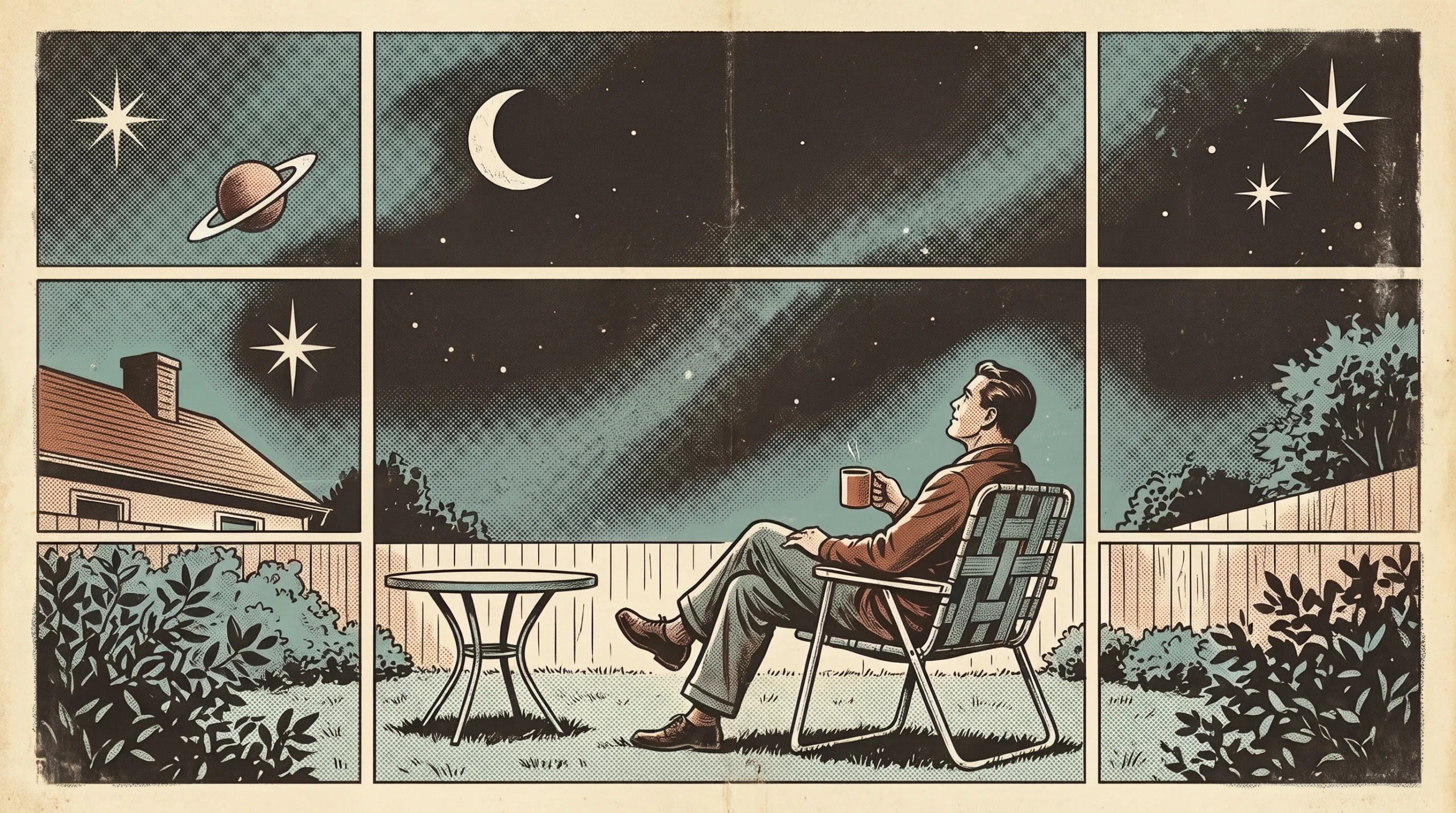
Stargazing, though? Stargazing is just stepping outside with a warm mug, clicking the porch light off, and getting comfortable with the neighborhood overhead.
No quizzes. No gear lists. No pressure to ever graduate beyond sitting under a dark sky in a lawn chair and your drink of choice.
If you stay a casual stargazer for the rest of your life, you’re still awesome. Kids love someone who can point out Jupiter and know where to look to catch a few autumn meteors. Not everyone knows that gathering of stars is Orion climbing over the garage roof in December. It’s fine. You don’t need to be a comet hunter. Yet.
This entire first module exists to make you feel completely at home up there, starting with the most basic question of all: what is all that stuff?
What You’re Actually Looking At When You Look Up
On a clear night, especially in a dark sky region, the skies can be a lot to take in. Once you know what to look for, though, that chaos sorts itself into three very different characters.
1. The Moon
Let’s start with the obvious one. The Moon is the easiest target in the sky and depending on the night, either your best friend or your biggest nuisance.
Even with zero optics, you aren’t just looking at a glowing white disc. Those dark, dusky patches are maria (ancient plains of cooled volcanic basalt that early astronomers mistook for seas), and the bright, rough patches are heavily cratered highlands.
Here’s a counter-intuitive tip for our stargazers: the Full Moon is the worst time to observe the Moon.
When it’s full the sunlight hits the surface straight-on, flattening every shadow and turning the whole thing into a blinding floodlight that washes out the fainter stars around it. The best is a crescent or quarter Moon. To the naked eye the contrast is gentler, and the rest of the sky stays dark enough to enjoy.
And before you ask, no you can’t see the moon landing sites. Even with a giant telescope. We’ll explain why later.
2. Planets
You’ve seen them. You probably know them when you do see them. That ridiculously bright, blazing-white “star” hanging low in the west, not twinkling, isn’t a star.
That was Venus.
She isn’t the only one. There are five planets bright enough to see easily with your unaided eyes and you can tell them apart from stars in about five seconds flat:
- Stars twinkle, planets don’t. Stars are so unimaginably far away that their light reaches us as a razor-thin pinpoint, easily scrambled by pockets of turbulent air in Earth’s atmosphere. Planets are much closer, so they present a tiny disc of light that resists atmospheric jitter. If a bright dot looks solid and unwavering while its neighbors shimmer, you’re looking at a planet.
- They stick to the same highway. All the planets orbit the Sun in roughly the same flat plane, which means they travel along the same invisible arc across our sky (called the ecliptic). You will never see Jupiter hanging out near the North Star. We’ll learn more later.
- They have subtle color. Venus is a bright white, Jupiter is a creamy ivory, Saturn glows a soft butterscotch, and Mars (my favorite) is a distinct rusty orange.
3. Stars (Distant Suns in Slow Motion)
Everything else twinkling overhead is a star, giant balls of gas burning billions of miles away1.
Give your eyes a few minutes in the dark and you’ll realize stars aren’t all white either. Their colors are like a thermometer. Hot massive stars burn icy blueish white (like Rigel or Sirius), middle stars (like our Sun) glow yellow-white, and cooler supergiants smolder orange or red (like Betelgeuse and Aldebaran).
And unlike planets which visibly drift from constellation to constellation over weeks and months, stars stay locked in the exact same patterns relative to one another for your entire lifetime.
Which brings us to the oldest map system humans ever invented.
Constellations: What even are they
Constellations aren’t just the position of the sun when you were born or the barometer for your love life and relationships. (I’m a Sag if you’re asking.) But if you’re out here with us under the stars, you have a pretty good idea of what they are when it comes to stargazing.
But under these dark skies, all those charts and dotted lines don’t make sense anymore. How the heck did they see all those shapes?
Modern astronomers (that’s us!) treat the 88 official constellations less like storybook drawings and more like states on a map. Every square inch of the night sky belongs to one of those 88 regions with invisible borders drawn between them. When our daily Field Guide tells you to look for a meteor shower or a bright planet “in Leo,” it’s just giving you a zip code.
We should calm down. You don’t need to memorize all 88 of those zip codes. If you’re in the Northern Hemisphere you really only need to make friends with three.
The Big Three: Your Year-Round Sky Anchors
If you learn nothing else, learn these three shapes. Between the lot of them, there is at least one is always sitting clearly in view no matter what month you step outside.
1. The Big Dipper (Spring & Summer’s Heavy Hitter)
Technically, the Big Dipper isn’t a full constellation. It’s an asterism, a recognizable group of stars inside the much larger constellation Ursa Major, the Great Bear.
Four bright stars form a sturdy rectangular bowl and three more curve off into a slightly bent handle. Because it sits near the northern celestial pole, the Big Dipper never fully sets for most observers in the United States. In spring evenings, you’ll find it riding high overhead. In autumn it scrapes low along the northern horizon.
2. Cassiopeia (The Big Dipper’s Opposite-Side Backup)
What happens in late fall when the Big Dipper is hiding behind your neighbor’s oak trees? You turn your eyes up to Cassiopeia. It was the first one I got really good at spotting.
Sitting directly across the northern sky from the Big Dipper Cassiopeia is five bright stars arranged in an unmistakable W (or an M, she rotates just like the Dipper does). Whenever the Big Dipper is low and blocked by horizon or houses, Cassiopeia rides high overhead. Together, they work like two seats on opposite ends of a Ferris wheel: one of them is always up.
3. Orion the Hunter (The King of Winter)
From late October straight through early April, Orion owns the southern sky. Even from a light-washed suburban driveway, he is impossible to miss.
Look for a tall, tilted hourglass made of four bright corner stars, namely the orange-red Betelgeuse2 on his upper-left shoulder and the blue-white Rigel at his lower-right foot. Cinched tightly right across his waist are three nearly identical, evenly spaced stars sitting in a neat diagonal row: Orion’s Belt. Once you spot that three-star belt, the rest of the winter sky snaps into focus around it.
Wait… What Is That? (It’s Always Pleiades)
Spend five minutes in any online stargazing group between October and March, and you will see the exact same post appear like clockwork:
“Hey everyone, I saw this tiny, super-cute cluster of stars tonight. Was that the Little Dipper? Or a UFO? Or Starlink?”
Let’s save you the trouble right now.
It’s the Pleiades. It is always the Pleiades.
Officially cataloged as Messier 45 (M45) and nicknamed the Seven Sisters, the Pleiades is a glittering, compact open star cluster riding on the shoulder of Taurus the Bull, not far above and to the right of Orion. To the naked eye, it looks like a miniature, misty silver question mark or a doll-sized dipping ladle, way way smaller than the actual Little Dipper (which is much larger and noticeably fainter).
Most people with decent skies can count six or seven tight blue-white stars huddled together inside a faint, frosty haze. Under a suburban glow, you’ll often spot it out of the corner of your eye first, a tiny celestial smudge that sharpens into a jewel box the moment you look near it.
Every single backyard observer has the exact same moment of discovery with the Pleiades. Consider spotting it your official welcome badge into the club. Just wait til you get them in your scope.
Next Up in Module 01: Putting the Map in Motion
Alright stargazer, now that you can tell a steady planet from a twinkling star and confidently identify the Pleiades without mistaking it for an alien fleet, you’re ready to start navigating.
In the next lesson, we’ll turn your outstretched hand into a fancy and eerily accurate sky ruler and show you how to use the Big Dipper, Orion, and Cassiopeia as astronomical signposts to find the North Star. Then we’ll hop across the sky without touching that fancy phone app you just bought to identify the stars.
- Continue to Lesson 1.2: Getting Around the Sky: Hand Angles, Signposts & Star-Hopping
- Return to the Hub: Module 01: Naked Eye Observations
- Step Outside Tonight: Check Tonight’s Daily Field Guide to see which planets and Big Three landmarks are up after sunset.