
Tonight’s Sky Guide: November 20, 2026
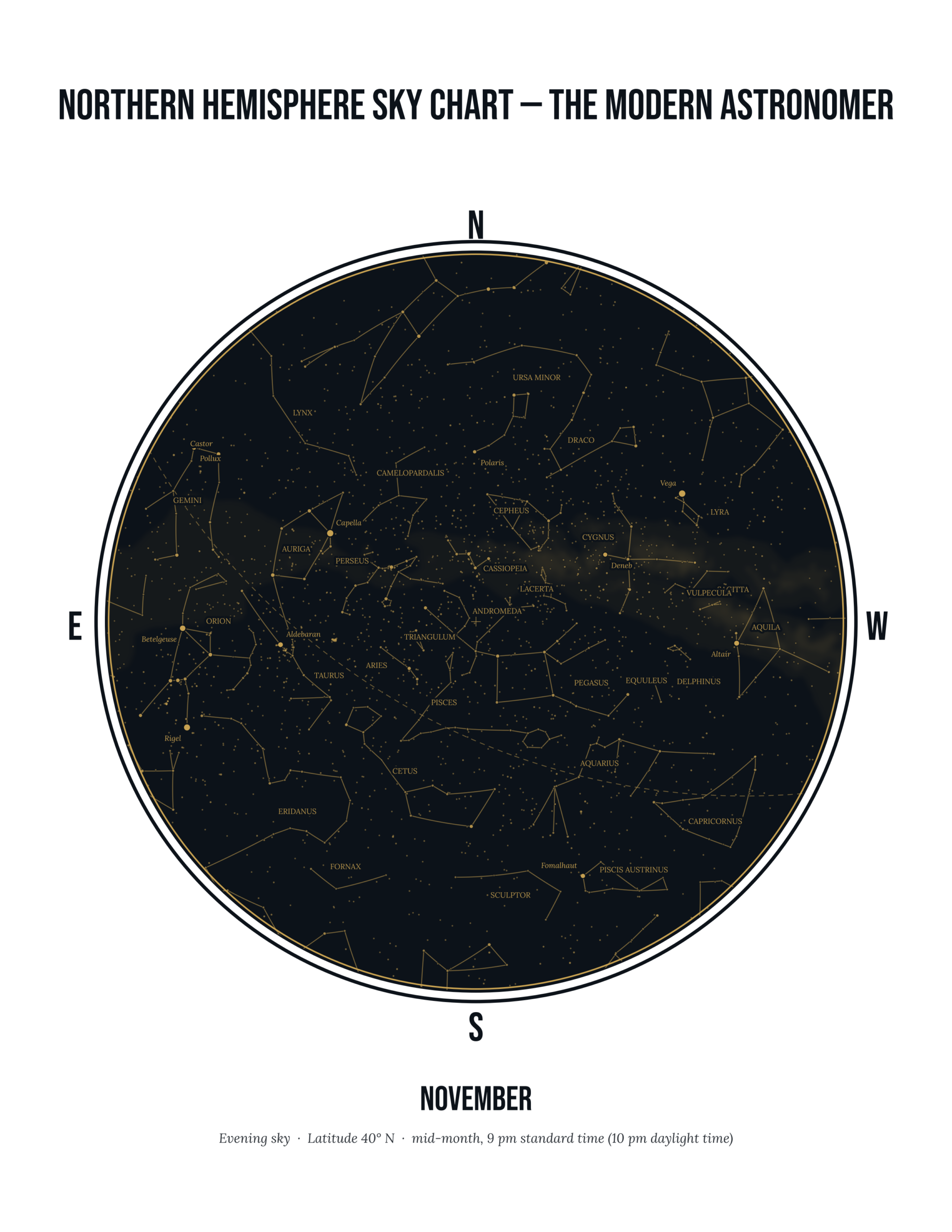
Grab your warmest winter jacket and step outside tonight, November 20, 2026, to catch a brilliant waxing gibbous Moon sharing the sky with the majestic constellations of the approaching winter season. While the moonlight washes out fainter deep-sky objects, bright planets and sparkling star clusters shine proudly through the crisp autumn air.
Naked-Eye Observers
- Saturn: Look high in the southern sky after dusk as a steady, golden-yellow “star” glowing in the constellation Aquarius.
- Jupiter: Rising in the east-northeast late in the evening, the king of planets blazes with unmistakable, dazzling white brilliance.
- The Summer Triangle: Catch the western descent of Vega, Deneb, and Altair, marking the final farewell of the warmer stargazing months.
- The Great Square of Pegasus: High overhead in the south, use this massive celestial landmark to navigate your way across the autumn vault.
Binocular & Small-Scope Observers
- The Pleiades (M45): Climbing high in the east after 9:00 PM, this shimmering cluster of blue sub-giant stars looks breathtaking in low-power binoculars.
- The Andromeda Galaxy (M31): Though dimmed slightly by the bright Moon, our nearest galactic neighbor is still visible as a glowing oval smudge northwest of Cassiopeia.
- Saturn’s Titan: Point a small telescope at Saturn to spot its largest moon, glowing like a tiny speck just outside the ring system.
- The Double Cluster in Perseus: Sweeping your binoculars between Perseus and Cassiopeia reveals a glittering pair of open star clusters.
Large-Scope Observers & Astrophotographers
- Jupiter’s Great Red Spot: Use high magnification during a steady seeing window to track the transit of the giant storm and the dance of the Galilean moons.
- Uranus and Neptune: Both ice giants are well-placed for imaging; Neptune sits in Aquarius while Uranus glows in Taurus, appearing as tiny, greenish-blue disks.
- Lunar Craters: Point your telescope at the terminator line of the waxing gibbous Moon to capture dramatic, high-contrast shadows along crater rims like Copernicus and Tycho.
- Planetary Nebula NGC 7662 (The Blue Snowball): Test your deep-sky resolution on this bright planetary nebula in Andromeda using narrowband filters to cut through lunar light pollution.
Learn More
- Sky & Telescope: For up-to-date observing guides, charts, and astronomical news.
- EarthSky: Excellent daily updates on planet sightings, Moon phases, and celestial events.
- Stellarium Web: A free, interactive browser planetarium to help you precisely map out tonight’s sky.