

Tonight’s Sky Guide: November 19, 2026
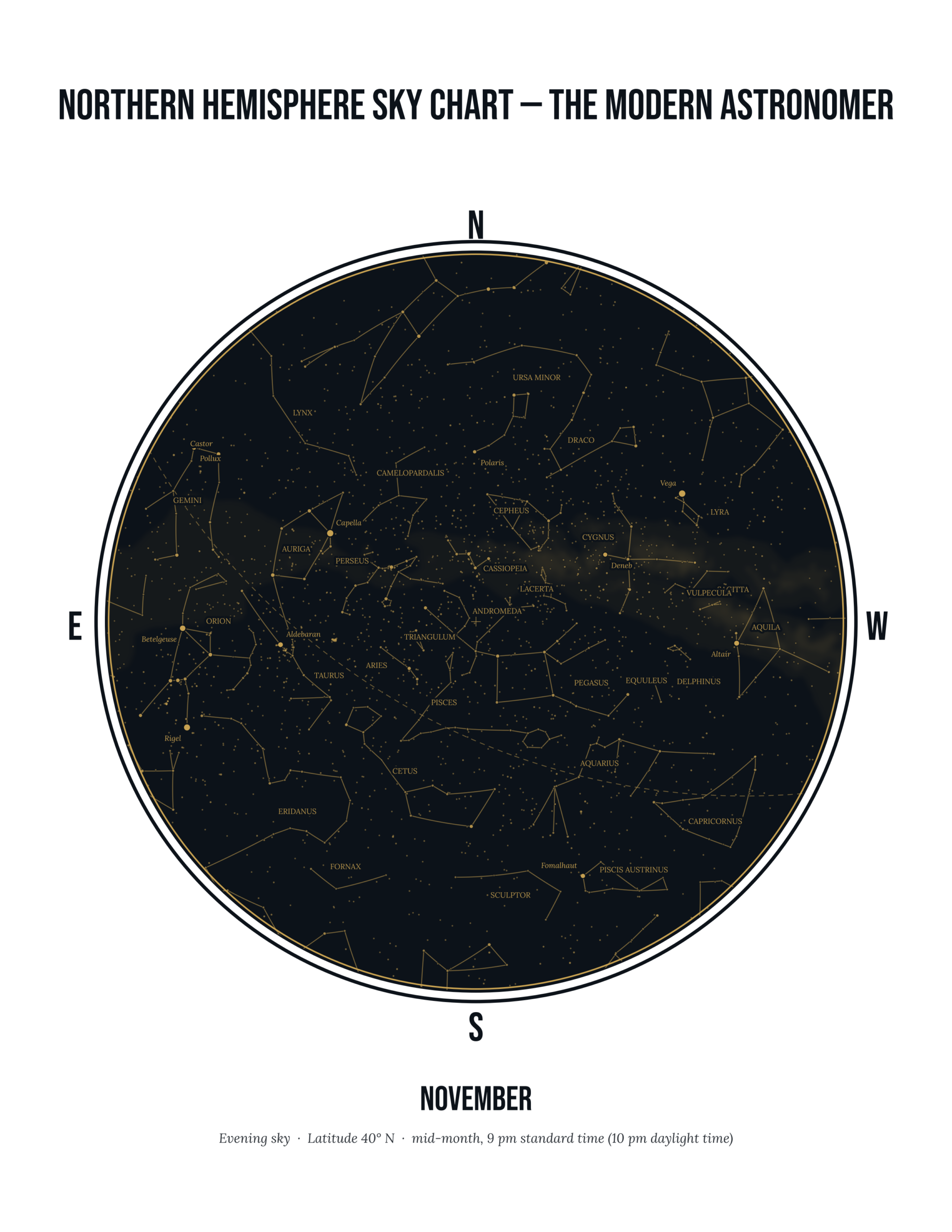
Tonight’s standout spectacle is the close pairing of Mars and Jupiter rising together in Leo around midnight, alongside lingering pre-dawn Leonid meteors after the waxing gibbous Moon sets. In the evening sky, Saturn shines steadily in the south while brilliant Venus emerges low in the east-southeast before sunrise.
Naked-Eye Observers
- Evening Moon & Saturn: Spot the bright waxing gibbous Moon high in the south after dusk, with golden Saturn glowing steadily in the southern sky.
- Midnight Planet Duo: Look east around local midnight to see bright Jupiter and ruddy Mars rising close together beneath the sickle of Leo.
- Pre-Dawn Highlights: Once the Moon sets in the early morning hours, watch for occasional swift Leonid meteors and spot dazzling Venus above the east-southeast horizon before twilight.
- Autumn Constellations: Trace the Great Square of Pegasus high overhead, the “W” of Cassiopeia to the north, and the Pleiades (M45) climbing in the east.
Binocular & Small-Scope Observers
- Lunar Terminator: Scan along the Moon’s shadow line to reveal sharp relief across craters, mountain ranges, and dark lava plains.
- Jupiter’s Moons & Saturn’s Rings: Fit Jupiter, its four Galilean moons, and Mars in a single wide binocular field, or aim a small telescope at dusk to see Saturn’s rings and Titan.
- Moon-Resistant Clusters: Sweep through the Pleiades (M45) in Taurus, the Double Cluster (NGC 869/884) in Perseus, and the Owl Cluster (NGC 457) in Cassiopeia.
- Colorful Doubles: Split Gamma Andromedae (Almach) in a small scope to contrast its golden-orange primary star with a pale blue companion.
Large-Scope Observers & Astrophotographers
- Planetary Imaging: Capture high-frame-rate video of Saturn in the early evening and Jupiter before dawn when each climbs highest through steadier air.
- Narrowband Emission Nebulae: Use H-alpha and O-III filters to cut through evening moonlight on the Pacman Nebula (NGC 281), the Heart and Soul Nebulae, or the California Nebula (NGC 1499).
- Pre-Dawn Deep Sky: Wait until moonset in the early morning hours to target the Orion Nebula (M42), the Horsehead Nebula (IC 434), or faint galaxy groups in Leo and Ursa Major.
Learn More
- NASA Skywatching – Monthly sky highlights, planet visibility, and viewing tips.
- Sky & Telescope Observing – Detailed sky charts, observing guides, and celestial event updates.
- Stellarium Web – Interactive online planetarium to preview tonight’s sky from your exact location.